E-commerce in Morocco looks simple from the outside: an online store, good photos, an ad, orders. What actually makes or breaks a Moroccan store is almost never the website. It is the payment chain, the last mile, and whether anyone is there to answer when ten people order on the same day. This article follows the order in which those decisions really arrive.
Where does e-commerce in Morocco actually start?
E-commerce in Morocco starts with payment and delivery, not with the website. Those are the only two steps you do not fully control: each one depends on a bank, a payment provider or a carrier, and each one has its own lead time and its own conditions. The store itself gets built once the rest is settled.
The order that works: know what is left on an order once shipping and packaging are paid for; decide how you collect the money; choose who delivers, where, and within what deadline you can commit to; name the person who answers customers; build the store; then go get traffic. Many projects reverse this. The store is ready, the ads are running, and orders arrive before the payment chain exists. That is the most expensive mistake available, because you pay for it in disappointed customers at the exact moment you become visible.
What has to be settled before you open an online store?
Before opening an online store, you need a properly registered business, a stable catalogue and someone who answers. A registered business, because the payment acceptance contract, the carrier contract and your terms of sale are all signed in the name of an identifiable entity, whose legal details then have to appear on the store.
A stable catalogue, because an incomplete product page is a lost order: every item needs a clean photo, the exact name, the size, the price, real availability and a delivery time. If three hundred references exist but only forty are genuinely in stock, open with forty. And someone who answers, because in Morocco a large share of online sales closes inside a conversation — a visible, genuinely monitored WhatsApp number beats a contact form nobody checks.
How do you accept online payments in Morocco?
Accepting card payments on a Moroccan website requires a contract with an institution that handles online acceptance. The Centre Monétique Interbancaire presents an offer for e-merchants on its own site, described as « Solutions sécurisées de paiement en ligne pour vos sites marchands » (cmi.co.ma, consulted 6 November 2026). That contract takes preparation — a file to assemble and a lead time worth anticipating before you announce a launch date.
One fact is worth knowing before you even choose a platform: Shopify Payments is not available in Morocco. Shopify's official supported-countries page lists 41 countries and regions, and Morocco is not among them; Shopify states that merchants outside that list must use a third-party payment provider (help.shopify.com, "Supported countries for Shopify Payments", consulted 6 November 2026). A Moroccan Shopify store works perfectly well, but card collection goes through an external gateway: one more contract, one more integration, one more delay. While the banking file progresses, many Moroccan stores open with cash on delivery alone.
Does cash on delivery change how your store is built?
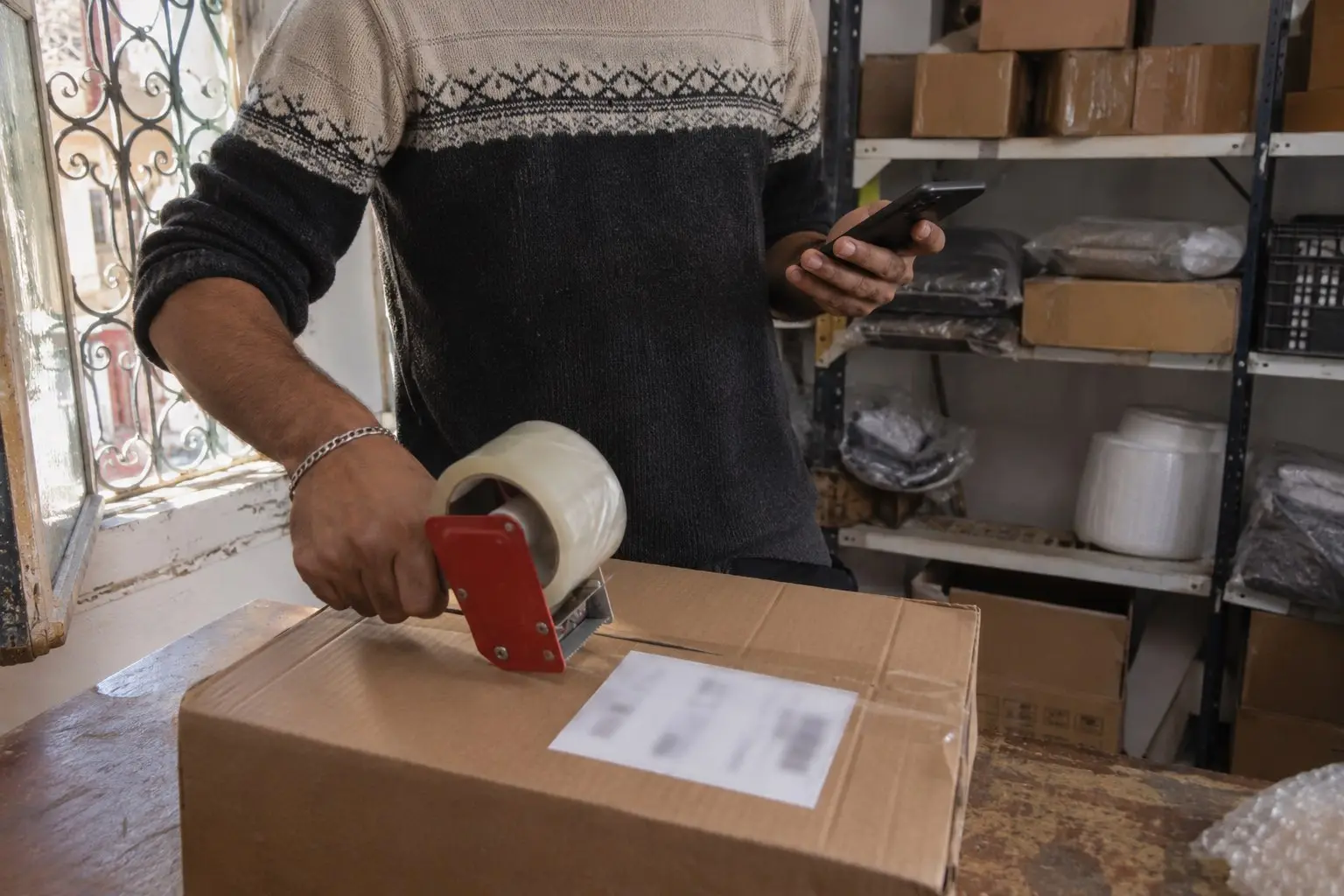
Cash on delivery changes how a Moroccan store has to be built, because it moves the risk from the customer to the merchant: you pick, pack and ship a parcel before collecting anything, and you are paid once the carrier remits the funds.
Three consequences follow. An order is not a sale — until the parcel is handed over and paid for it is an intention, and your dashboards must separate orders placed from orders collected. A refusal costs twice — the outbound trip, the return, the packaging and the handling time. The only effective defence is confirmation before dispatch: a message that checks the address, the product and whether the recipient will be there. Checkout must capture a reachable phone number, because a vague address and a number that never answers are enough to turn an order into a straight loss.
How do you organise delivery and returns?
Delivery is decided before the website, because it determines which zones you can advertise and which deadline you can commit to. Choose a carrier on the real coverage of your selling zones, and ask explicitly how often cash-on-delivery funds are remitted to you: that frequency dictates your cash flow. Then advertise only what you can hold — a cautious deadline that is met beats an attractive one that is missed. Put a written return policy in place from day one: what you take back, in what condition, within what window, and who pays for the return. Not having one does not remove returns; it only forces you to improvise.
Which platform suits which stage?
The right platform depends on the stage you are at, not on what is fashionable. Three situations recur in Morocco.
You are still testing an offer. If you do not yet know whether the product sells, a well-kept Instagram catalogue and orders taken over WhatsApp are enough to find out, with no store and no commitment.
You are already selling and want to industrialise. This is the moment for a hosted platform such as Shopify: catalogue, cart, cash on delivery, stock, several languages, and updates you do not have to manage. That is the route chosen for two stores built by Artcom Solution — Parfumerie MAMA, a Marrakech perfumery that wanted to sell across Morocco, and Gelato Factory, a gel nail strips brand.
You want full control, hosting included. WordPress and WooCommerce give you that freedom and, with it, responsibility for updates, plugins, security and performance. A good choice when that skill exists in your team, a bad one when it exists nowhere.
Custom development is only justified when the store has to do something no existing product does: unusual subscriptions, complex pricing logic, a connection to an internal management system. That is the territory of Tech & AI, not the starting point of a first project.
Which languages should you sell in?
A Moroccan online store benefits from existing in at least French and Arabic, because customers do not all search in the same language or read in the same direction. Arabic is not solved by translating labels: the layout has to flip right to left, prices, quantities and forms included. A half-flipped Arabic store is spotted in a second, and it costs exactly the trust it was meant to earn. The Parfumerie MAMA store exists in French, English and Arabic, Gelato Factory in French and Arabic; English earns its place when the audience includes travellers or Moroccans living abroad.
What does Moroccan law say about selling online?
Distance selling in Morocco is governed by law 31-08 on consumer protection, whose text is published on the Ministry of Justice legal portal (adala.justice.gov.ma, consulted 6 November 2026). On personal data, the competent authority is the Commission nationale de contrôle de la protection des données à caractère personnel: the CNDP site lists, under « Mes démarches », a declaration to notify, a request for prior authorisation and a request for transfer abroad (cndp.ma, consulted 6 November 2026). An online store collects names, addresses and phone numbers, so it is concerned. This article is not legal advice — have your terms of sale and privacy policy reviewed by a lawyer.
How do you know the store is ready to open?
Your store is ready when you can handle ten orders in a single day without improvising. Six points confirm it:
- Every product page has a photo, a price, availability and a delivery time.
- The payment method is live and has been tested with a real order.
- The carrier is chosen, and zones and deadlines are written on the site.
- Someone is named to confirm orders and answer messages.
- Terms of sale, return policy and privacy policy are published.
- You know what is left on an average order once everything is paid.
If one of those lines is missing, the website is not the problem. Traffic comes only afterwards: social content, paid advertising and search — the work covered by Scale Up for a business already online and by Go Digital for one starting from nothing. You can also look through our work and our services. If you are unsure about the order of the steps in your case, that is what the Growth Blueprint covers — free, delivered in 72 hours — or you can simply write to us.