
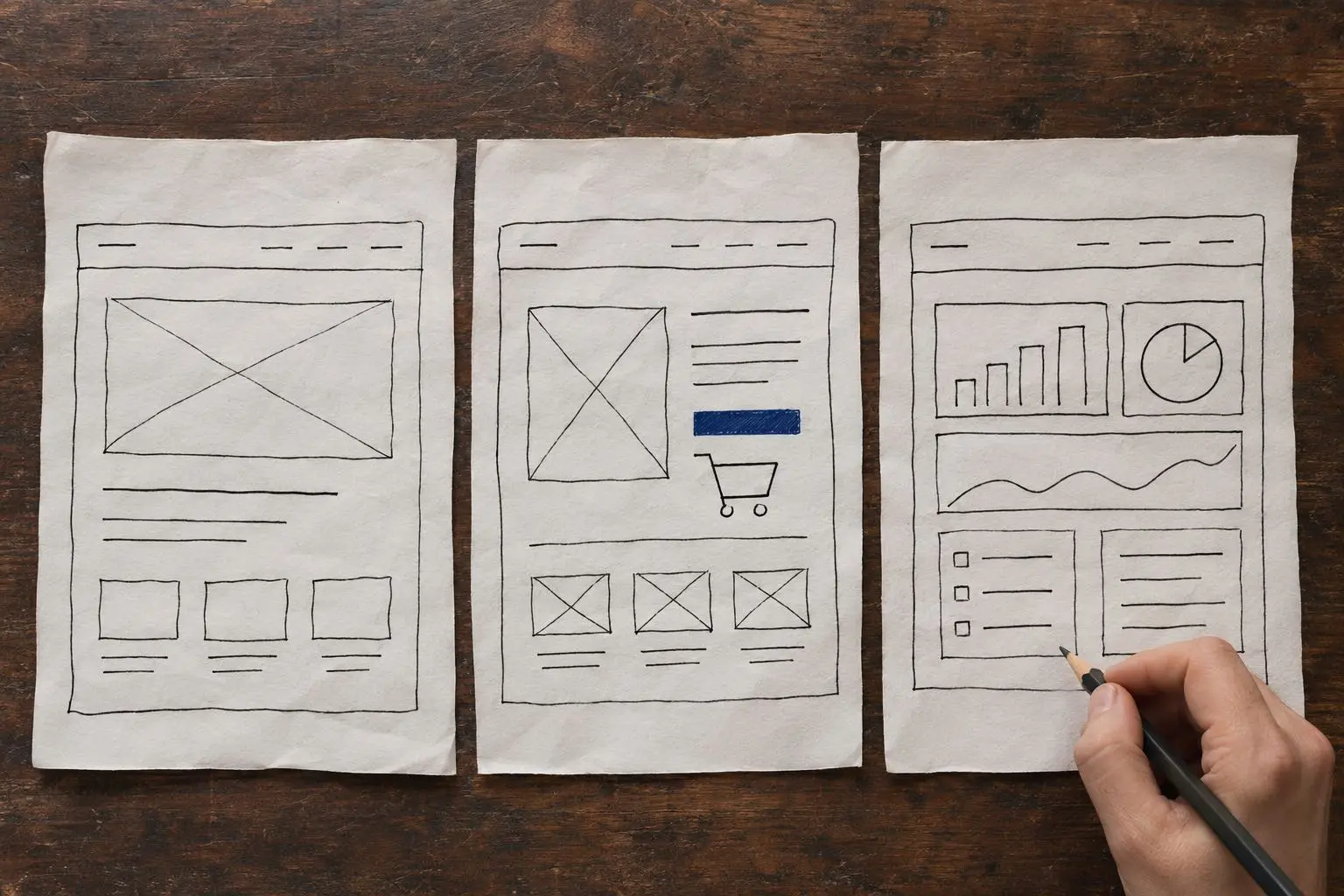
It is the question asked in almost every first conversation: do you need a brochure site, an e-commerce store, or a custom build? All three go by the same name — "a website" — and none of them takes the same work, the same timeline, or the same commitment once it is live. This article compares them honestly, including the cases where the right answer is to build nothing at all.
Brochure site or e-commerce: how do you decide?
You decide by answering a single question: what does the site have to do? A brochure site has to convince someone to get in touch. An e-commerce site has to take an order without you. A custom build has to run an operation that nothing off the shelf can run.
This is not a question of size or budget, it is a question of role. To test your answer, turn it around: if the site disappeared tomorrow, what exactly would you lose? Phone calls, orders, or your working tool?
What is a brochure site, and who does it really suit?
A brochure site is a site whose job is to produce a contact, not to close a sale. It suits businesses where the transaction ends somewhere else: at a doctor's or a lawyer's office, in a restaurant, on a site visit, in a negotiated quote. In other words, most service businesses.
A useful brochure site does four things: it answers the questions people ask before they call — what you do, for whom, where, on what terms; it loads fast on a phone, because that is where it will be read; it makes contact immediate, without a twelve-field form; and it is findable, which means a maintained Google Business profile as much as good search ranking.
The common mistake is to treat it as "a small site". A brochure site is not a reduced site: all its work sits in the writing, the proof and the clarity. ChanaaCar, a car rental company in Marrakech, belongs to this family — the site exists in four languages and leads to a booking or a WhatsApp request.
When do you need an e-commerce site rather than a brochure site?
You need an e-commerce site when the transaction can close without you. If the product is standardised, the price can be displayed, the stock is known and a carrier can deliver it, the sale no longer needs a conversation, and a store becomes the right tool.
What almost everyone underestimates is that e-commerce is not a website, it is an operation: product pages kept current, accurate stock, after-sales, a return policy, and someone confirming and chasing orders every single day. The site is the easiest part of the whole thing. That is true of Parfumerie MAMA as it is of Gelato Factory — the store is the finish line, the daily work is elsewhere.
If every price is negotiated, or if what you really sell is expertise, a store will cost you work without bringing in orders. A brochure site with a well-built quote form serves that kind of business better.
WordPress or a custom site: which should you choose?
For most businesses, WordPress — or an equivalent platform — is more than enough, and a custom build is only justified when the site has to do something no existing product does. That is the honest answer, even coming from a team that builds custom software.
WordPress has three real advantages: it goes up quickly, anyone can edit the content, and there is a plugin for almost everything. It also has three real costs, discovered later: updates, plugins and security become recurring work; performance degrades as plugins pile up; and a purchased theme looks, by design, like thousands of other sites.
A custom build is the mirror image: it fits the way you actually work, depends on no plugin chain, and its performance can be steered. In exchange, it needs a written specification, it takes longer, and someone will have to maintain it. That is what we build for products such as Gestio or Hospikit, where the software is the service being sold.
So the real question is not "which is better". It is: who will look after it in eighteen months, and with what resources?
When should you not commission a custom site?
You should not commission a custom site when your problem is not your site. That happens more often than people expect, and it shows up in four ways.
You have not validated your offer yet. While you still do not know which message makes customers react, a custom site freezes untested assumptions into code.
Your problem is traffic, not the site. If your current site works but nobody visits it, a new site changes nothing. The work belongs on the visibility side — Google Business profile, search, advertising — which is what Scale Up covers.
You need five pages that explain what you do. A standard platform does that very well, faster, and you will be able to edit it yourself.
Nobody on your side can supply the content. A custom site does not invent your photos, your rates, your opening hours or your argument. Without content, the finest build is an empty shell.
If you recognise yourself in one of these, you do not need a custom site, and we will say so during the diagnostic: if we are not the right fit, we say so honestly. It is written on the Growth Blueprint page.
How long does it take to build a website?
A website's timeline depends less on the technology than on content and decisions. The schedules published on our services pages give the real order of magnitude: for a business coming online with Go Digital, the diagnostic takes week 1, brand and site weeks 2 to 5, and launch week 6. For a Tech & AI project, the product workshop takes 1 to 2 weeks, design 3 to 5 weeks, and development 2 to 4 months.
What actually stretches a project is almost never the code. It is content that does not arrive, review cycles, the number of languages, integrations with existing systems — payment, stock, bookings — and migrating an old site whose addresses have to be preserved. A site like Breizh Global, published in Arabic, French and English, means every page is written and proofread three times.
Be wary of speed records: a site delivered in a few days is a site whose content nobody reviewed.
What makes a website cost more or less?
A website's cost varies with five things: scope, integrations, content, the number of languages, and what happens after launch. Scope is the number of genuinely different journeys — a product page and a booking page are not the same component. Integrations are everything that has to talk to something else: payment, stock, CRM, calendar, invoicing. Content — writing, translation, photography — is the most underestimated item of all. Languages multiply both the writing and the proofreading, and Arabic adds a full right-to-left layout to test. Finally, the after: hosting, backups, updates, changes.
Artcom Solution does not publish rates, and that is deliberate: a figure without a scope means nothing. What can be said safely is the order of effort — a brochure site is mostly content, a store is content plus an operation, a custom build is a specification, a development and a maintenance commitment.
Which signals tell you which one you are?
Three sets of signals usually settle it.
You are a brochure site if customers call before buying, if your prices depend on the case, if your work sells on trust, or if what you mainly want is to be found and reached.
You are an e-commerce site if you have identical products, a displayable price, stock, a carrier, and someone able to process orders every day.
You are a custom project if the site is not a presentation but a tool: a customer area, bookings with rules, a dashboard, business software, an application. In short, if what you are describing is not sold off the shelf.
And if two descriptions fit, start with the one that funds the other. Our work shows what each of these families looks like; who we are answers the rest, and you can always write to us.