SEO in Morocco is not won where most advice places it. On local commercial queries, the first position on the results page is not a blue link: it is a business listing. An SEO plan copied from a French or American blog therefore polishes a position the Moroccan searcher sees fourth. This article starts from what a Moroccan results page actually looks like, then works out what to do and in which order.
What is SEO, and what is different about it in Morocco?
SEO is the work that makes your pages appear in Google's unpaid results, as opposed to the ads you buy. Three things set it apart in Morocco. One market searches in three languages, often across a single website. Search happens overwhelmingly on a phone, which shortens the visible page to two or three items before the first scroll. And above all, the shape of the results page on local commercial queries is not the one the textbooks describe.
Why is the first organic position not the first position on the page?
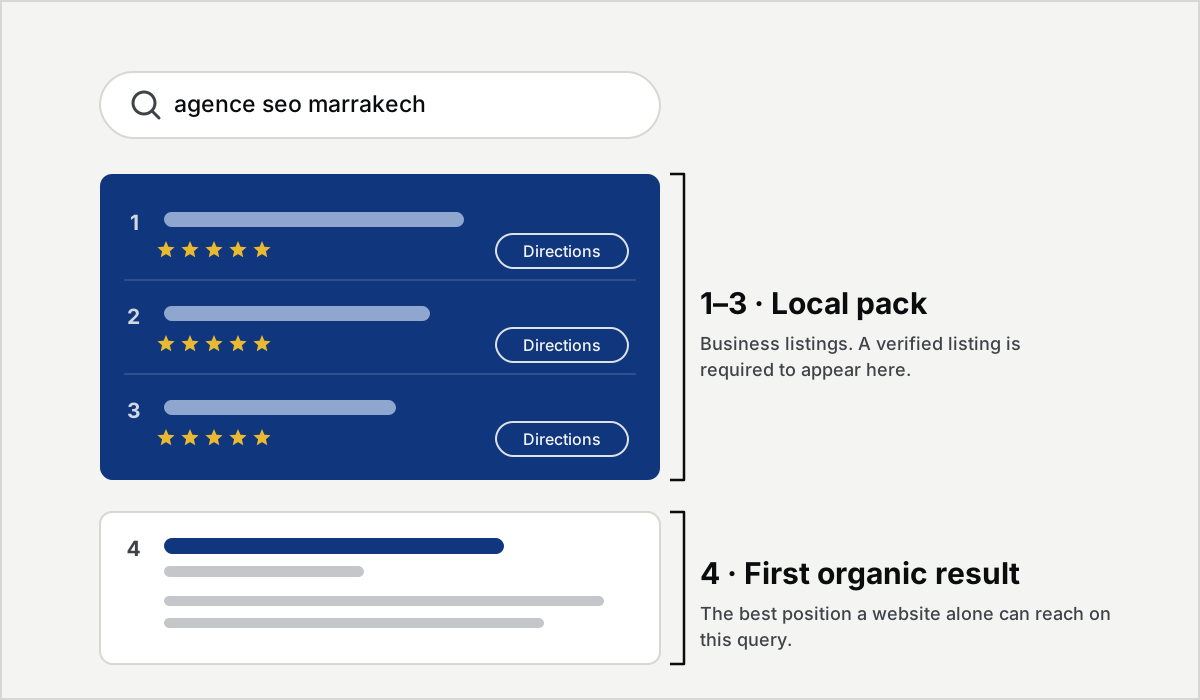
On Moroccan local commercial queries, the first three visible positions are taken by the local pack — three Google business listings with rating, reviews and directions — and the first organic result only appears in fourth visible position. A site that ranks "first organic" is therefore fourth on screen, behind three competitors who may not even have a website.
Measured on Google in French from Morocco on 6 November 2026, on the queries "création site web marrakech" and "agence seo marrakech": positions 1 to 3, local pack; the first organic link comes after. A results page changes and varies by device and location, so re-run the check on your own queries before building a plan on it.
The consequence is structural. In Morocco, a local SEO plan has two fronts rather than one: the business listing and the pages of the site. Most of the advice available in French deals only with the second, because it is written for markets where the local pack weighs less in the decision.
What does it take to appear in the local pack?
To appear in the local pack you need a verified Google business listing, filed under the right primary category, with an accurate service area or address, recent reviews and current photos. Verifying the listing is a condition of being shown, not an option; it is stated in the Google Business Profile documentation, consulted on 6 November 2026.
Four settings make most of the difference. The primary category decides which queries the listing is eligible for: one primary category, chosen for what you sell most, the rest as secondary. A service area is the correct configuration for a business with no premises open to the public, and declaring it always beats inventing a walk-in address. Reviews are requested after a successful delivery and answered, all of them, the bad ones included; they are not bought. Photos and posts show that the listing is alive.
A fifth point lives on the site rather than the listing: name, address or service area, phone number and opening hours must be identical everywhere — listing, website, directories. Artcom Solution applies that rule to its own contact page, which publishes hours and channels but no walk-in address, because the agency keeps no office open to the public.
Which language should you write in for the Moroccan market?
Write first in the language the query is actually typed in, which in Morocco is most often French for commercial queries and Arabic for part of the local-service queries. The language of your business is not the criterion; the language of the search is.
For a multilingual site, three rules are enough. Each language gets its own complete, indexable addresses: an automatic translation widget does not create pages Google can rank. The versions declare each other with hreflang, as described in the Google Search Central documentation on localized versions, consulted on 6 November 2026. And a translated version gets proofread: a machine-produced Arabic page is recognisable, and it converts no better than it ranks.
Darija written in Latin characters shows up in real queries. Its place is inside answers — an FAQ, a paragraph — rather than in headings, where it would weaken the page. English serves the diaspora and foreign clients: that is the logic behind the multilingual sites Artcom Solution has delivered, such as ChanaaCar in four languages or Breizh Global in Arabic, French and English.
Which page should win which query?
A commercial query should be won by a service page and a question by an article: mixing the two loses both. "Agence seo marrakech" is a buying query and calls for a page that sells; "how long does SEO take" is a question and calls for an article that answers.
Two pages aimed at the same intent end up competing with each other. The symptom is visible in Search Console: on one query, the URL that surfaces changes from week to week and neither one climbs. The fix is to choose the page that should win, merge or repoint the other, and link the article to the service page with anchor text that says what the reader will find.
At Artcom Solution the split is explicit: visibility and growth queries lead to Scale Up, businesses still offline to Go Digital, product projects to Custom Tech & AI, and the services page holds the whole.
What replaced keywords?
Repeating a keyword no longer ranks a page; what counts is that a passage of the page answers the question completely and stays intelligible outside its context. Google now displays generated answers that lift a passage out of a page: if that passage opens with "this is why it is important", it is quotable nowhere.
Three writing habits follow. The section heading is the question, phrased the way a reader would ask it. The first sentence under that heading is the answer, whole, without deferring to what comes next. And the subject is named rather than replaced by a pronoun: "the local pack occupies the first three positions" survives being quoted, "it occupies them" does not.
The keyword keeps a place, but a limited one: the title, the H1, one section, the introduction, the description. Beyond that it only makes the text harder to read.
How much of the technical side really matters?
For most Moroccan sites, the technical side of SEO comes down to four things: being indexable, being fast on a phone, being correct in multiple languages, and telling Google what the business is.
Indexable means no tag blocks indexing by accident, a sitemap exists, canonical addresses are coherent, and the text is readable without running code in the browser. Fast is measured with Core Web Vitals — LCP, INP, which replaced FID in March 2024, and CLS — defined in the Google Search Central documentation, consulted on 6 November 2026. Correct in multiple languages comes back to hreflang and genuinely distinct pages. And structured data — organisation or local business, breadcrumbs, FAQ — states explicitly who you are, what you sell and where.
One honest caveat about this part: technical work does not rank a page that answers nothing. It stops a good page from losing.
How long before results, and how do you measure them?
SEO is built over several months, and it is measured in Search Console rather than in a rank report. Positions seen in your own browser are personalised and geolocated: they are impressions, not data.
Four numbers are enough to steer by. Impressions and clicks by query say what finds you. Average position by query says where you actually stand. The pages gaining and losing month over month say where to act. And on the listing side, calls, direction requests and messages say what the local pack returns. The monthly question is simple: which new queries find us, and which ones have slipped?
Which mistakes come up most often in Morocco?
Six mistakes recur often enough to be named. Inventing a walk-in address to look "more local" exposes the listing to suspension. Duplicating the same page with only the city name swapped produces pages nobody wants to read. Automatic translation with no hreflang and no proofreading creates pages that rank in no language. Publishing articles with no service page behind them brings readers but no customers. Buying reviews risks the whole listing for a temporary gain. And rebuilding a site without a redirect plan loses, in one day, addresses that took months to position.
How do you choose an SEO agency in Marrakech?
Choose an SEO agency in Marrakech on what it can show you inside your own Search Console, not on a ranking displayed in its portfolio. Three reasonable requirements: the accounts — Search Console, Analytics, business listing — are opened in your name and stay yours; every month produces something written that names what was done and what it returned; and the agency tells you what SEO will not fix in your business.
To know where you stand before committing to anything, Artcom Solution's Growth Blueprint audits your site, your local visibility and your competitors, then names what to fix first: free, delivered in 72 hours, and yours to keep. The agency works from Marrakech, in French, English and Arabic.