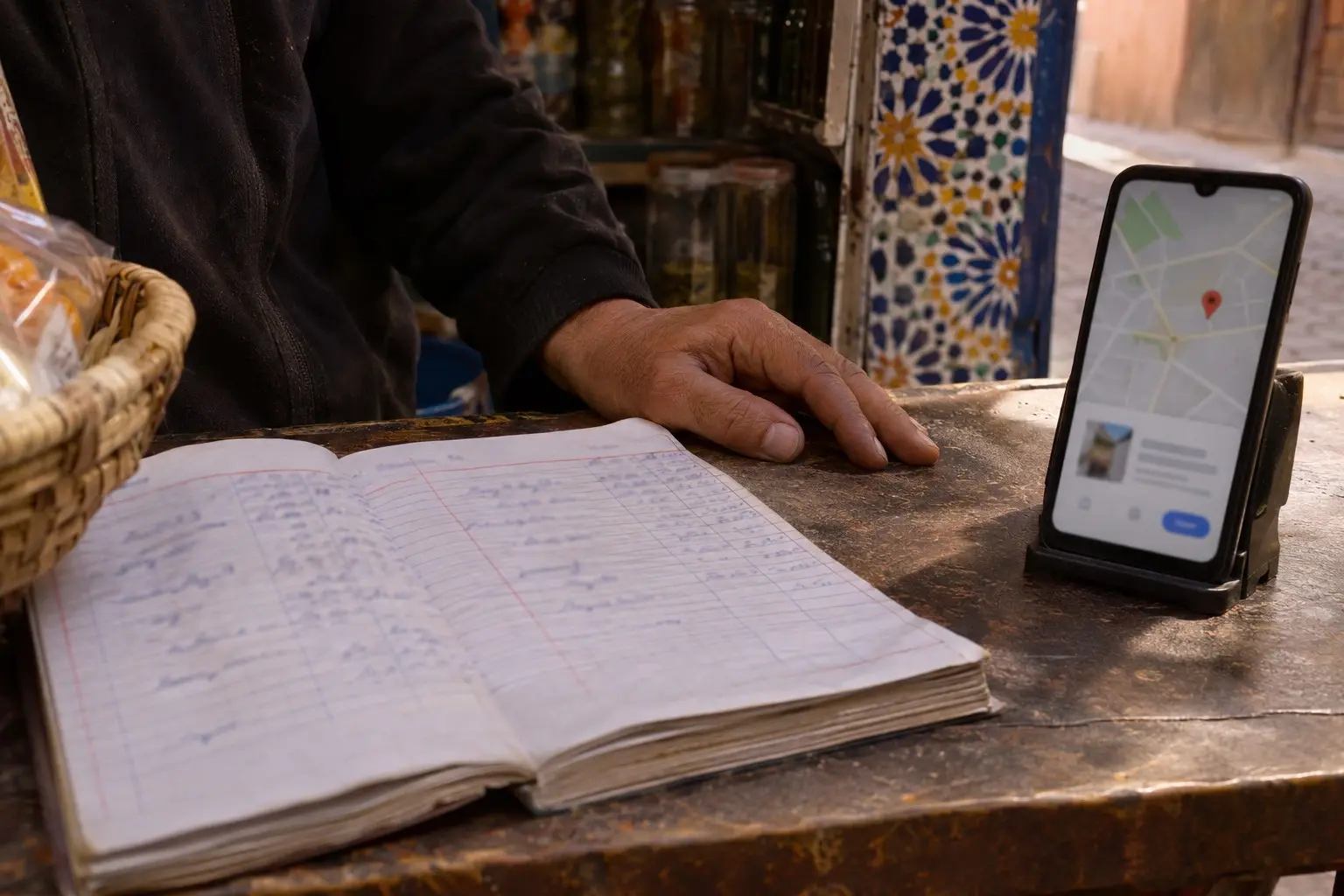
Digital transformation in Morocco rarely starts with a website. It starts the day a business that already exists — a clinic, a wholesaler, a workshop — becomes findable by people who have never heard of it. In between sits a paper ledger, an Excel file, and a phone that never stops buzzing.
This article sets out the path in the order it is actually walked, for a Moroccan SME that today runs its sales on WhatsApp and its stock on Excel. Each stage answers one question, and the last section says which ones you can skip.
What does digital transformation mean for a Moroccan SME?
Digital transformation for a Moroccan SME means moving three things: how customers find you, how they reach you, and how you know what is happening in the business when you are not there. It is neither a piece of software nor a website — it is the order in which those three moves are made.
Artcom Solution's Go Digital service describes the starting point in five sentences most owners recognise: your customers come mostly from word of mouth; you run everything on WhatsApp and Excel; you do not appear on Google Maps; a competitor who is no better than you has more customers; you tried advertising once, with no result. Those five sentences do not describe five problems. They describe one problem seen in five places: the business works, and nothing it does leaves a reusable trace — neither for being found, nor for being measured.
Should you start with a website?
No. A business that is invisible online should start with its Google Business listing rather than a website, and the reason is mechanical rather than philosophical.
On local commercial searches in Morocco, the top three positions on the Google results page are not organic results: they are Google Business listings grouped in a local pack, and the first organic result — the one a website can realistically aim at — appears in fourth place. Artcom Solution measured this on Google in Morocco on 6 November 2026, on the searches « création site web marrakech » and « agence seo marrakech ».
Two caveats are owed to that measurement. It covers those searches on that date, and a general question with no local intent does not trigger a local pack at all. And appearing in the pack is not automatic: the listing decides that, not the website.
The conclusion is an awkward one for a web agency to write, and it holds anyway: building a website before you have a verified listing means paying to compete from fourth place while the first three positions are free.
Stage 1: how do you claim and verify a Google Business listing?
Claiming a Google Business listing takes three moves: search for the business name on Google Maps, claim the listing if it already exists or create it if it does not, then pass the verification Google asks for before publishing it. An unverified listing does not enter the local pack, and this is the only stage in this article that costs nothing but time.
What matters next is not having a listing but having one a customer believes: the exact category for your trade rather than a generic one, real opening hours kept up to date through Ramadan and public holidays, a number somebody actually answers, photographs of the place as it looks today, and reviews the business replies to, including the bad ones. An abandoned listing does more damage than no listing at all — wrong hours send a customer to a closed door, and they will tell people.
Stage 2: what is a website for once you have a Google listing?
A website exists to answer the questions a Google listing cannot hold, and to receive the people the listing sends it. A listing says where you are, when you open and what others think of you; it does not say what you do exactly, for whom, on what terms, or why you rather than a competitor.
The useful minimum is a handful of pages: what you do, who it is for, how to reach you, and one page per service people search for by name — one page each, not a single "Services" page listing them all, because someone searching for one specific thing should land somewhere that talks only about that thing.
If your customers do not all speak the same language, the site has to show it. ChanaaCar, a car rental company in Marrakech, was built in French, English, Spanish and Arabic because its customers book from their phones on the way out of Ménara airport. Parfumerie MAMA went from one Marrakech shop to selling across Morocco with cash on delivery: there, the site was not a shop window, it was the new counter. Both sit among the projects the team has delivered.
Stage 3: how do you move management off Excel without breaking anything?
Getting off Excel starts with identifying the file you cannot afford to lose, not with choosing software. In most Moroccan SMEs it is the same file: the one that says who owes how much, to whom, and since when.
The test needs no consultant. If the person who keeps that file is away for three weeks, does the business still know who owes it money? If the answer is no, receivables are the first project — ahead of stock, and a long way ahead of cost accounting.
The rule after that never changes: digitise what is overdue before what is untidy. Badly arranged stock is still stock; a forgotten receivable is money gone. And migrate one thing at a time, because a full switchover on a Monday morning ends with everyone back on paper by Friday.
Stage 4: should you stop using WhatsApp?
No, and this is the most common misreading of digitisation in Morocco. WhatsApp is the channel your customers are already on; replacing it with a web form does not discipline them, it loses them.
The problem is not that you sell on WhatsApp. The problem is that WhatsApp is also your customer database, your order history and the memory of the business — three things a conversation cannot keep.
The right version keeps the door and changes what sits behind it: WhatsApp stays the way in, but what gets decided there ends up somewhere else. An order agreed in a chat is recorded in the management tool, an appointment made by message becomes a line in a shared calendar, and confirmations go back out over WhatsApp automatically, because that is where the customer will read them.
Stage 5: when is a Moroccan SME ready to advertise?
A business is ready to pay for advertising when it answers a message within one working hour and can say, a month later, how many customers a given channel actually brought in. Until both of those are true, advertising buys attention and pours it into a place that loses it.
"You tried advertising once, with no result" is the fifth pain listed on the Go Digital page, and the story behind it is always the same: the budget was the only variable anyone discussed, while the problem sat downstream — nobody answering in the evening, no page explaining the offer, no way of knowing where the enquiries came from. A campaign fixes none of those; it makes them visible faster, and more expensively.
Does every business need all five stages?
No, and claiming otherwise would be selling unnecessary work: the order of the stages is stable, the need for them is not.
A neighbourhood shop whose customers walk past the door mainly needs stages 1 and 2, in a light version. A wholesaler whose customers have been loyal for ten years has no visibility problem: what it loses, it loses in receivables, so its project is stage 3. A practice that lives on referrals does not need advertising — it needs to inspire confidence in someone who checks before calling.
The one stage we recommend to almost everybody is the first, because it is free and because its absence is visible to your competitors as well as your customers.
How long does it take to digitise an SME in Morocco?
The timeline depends on which stages you keep, not on the sector. At Artcom Solution the Growth Blueprint is delivered in 72 hours, a website then takes 3 to 6 weeks, and an app or a management system 2 to 4 months. The Google Business listing, by contrast, is claimed in a day and verified within a few days: it is the only stage whose timing barely depends on you.